Need a refresher on the QMP?
Understanding the details of the QMP is helpful to learn internon theory

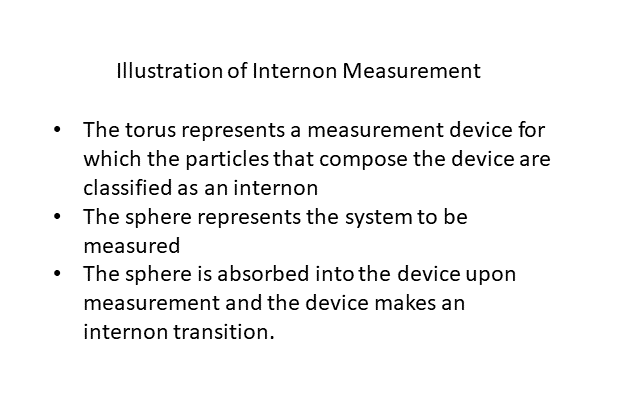
Never heard of an Internon?
Learn the basics of what constitutes an internon before reading further

Publications
Current plans for documenting internon theory
Complementary Relationships between Entanglement and Measurement
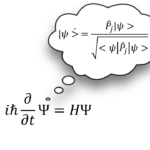
Complementary relationships exist among interference properties of particles such as pattern visibility, predictability, and distinguishability. Additionally relationships between average information gain Ḡ and measurement disturbance F for entangled spin pairs are well established. This article examines whether a similar complementary relationship exists between entanglement and measurement. For qubit systems, both measurements on a single system and measurements on a bipartite system are considered in regard to entanglement. It is proven that Ē + D ≤ 1 holds, where Ē is the average entanglement after a measurement is made and D is a measure of the measurement disturbance of a single measurement. Assuming measurements on a bipartite system shared by Alice and Bob, it is shown that Ē + Ḡ ≤ 1, where Ḡ is the maximum average information gain that Bob can obtain regarding Alice’s result. These results are generalized to arbitrary initial mixed states and non-Hermitian operators and direct results are found for the case of maximally entangled initial states. We conclude that the amount of disturbance and average information gain one can achieve is strictly limited by entanglement.
Exact Solutions for Spin Conserving Models and the Wigner-Araki-Yanase Theorem
The Wigner-Araki-Yanase (WAY) theorem is a well-known theorem regarding limitations of quantum measurement in the presence of additive conservation laws. Under the assumptions of the von Neumann measurement model, for which the system conserved quantity is bounded, given a conserved total additive system plus apparatus quantity L_SA, the measurement operator E_S must commute with L_S. Prior proofs have exploited the properties of unitary evolution constrained by momentum conserving operations that tend to obscure the physical nature of the WAY theorem and as well lead to bounds on performance. As it is generally agreed that momentum is always exactly conserved in measurement, we instead develop a general angular momentum conserving model of measurement. This model is shown to lead to a simple explanation of the major implications of the WAY theorem and provides exact results of the effects of measurement based on the apparatus model. This is shown by both tracing the apparatus from the density matrix and also via a system-only channel model based on Kraus operators.

Discrimination of Unitary Evolution and the Measurement Process
In von Neumann’s theory of quantum mechanics, two postulates exist—a measurement postulate by which the quantum state evolution changes by a discontinuous and non-deterministic process and a unitary postulate by which the quantum state evolution changes by a continuous and deterministic process. These two disparate processes form the basis of the quantum measurement problem. It is found that von Neumann’s two postulates perhaps are necessary, but cannot be considered to be sufficient to provide a complete theory. Furthermore, it is seen that the quantum measurement problem arises naturally from the ability, within the same theory, to discriminate these two processes. This is shown to lead to the incompleteness of quantum mechanics. A variety of test configurations are discussed which are capable of distinguishing whether the state evolution is occurring via unitary evolution or via measurement, a Unitary versus Measurement Discrimination Test (UMDT). A formal investigation of the theory of the discrimination of these two processes is undertaken and results are shown that the UMDT must lack commutation with the effects of the hypothesized measurement. The practical utility of UMDTs is demonstrated via several examples.
On Von Neumann’s Chain Theorem
In the von Neumann theory of quantum mechanics, two postulates exist—a measurement postulate by which the quantum state evolution changes by a discontinuous and non-deterministic process and a unitary postulate by which the quantum state evolution changes in a continuous and deterministic manner via Schrödinger’s equation. The issue of whether von Neumann’s chain theorem is sufficient to prove the consistency of these two postulates is investigated. It is shown that von Neumann utilized an assumption in his proof that limits the class of applicable Hamiltonians. It is proven that the class of unitary versus measurement tests (UMDT) are outside the von Neumann chain class of Hamiltonians. The von Neumann chain theorem does not imply the consistency of von Neumann’s postulates.